Random Thoughts on
Love and Fear
(and anything in between)

April 06, 2006

Well It Ain't No Secret

In the news today -
President George W. Bush authorized Vice President Dick Cheney in July 2003 to permit Cheney's chief of staff, I. Lewis Libby Jr., to leak to a reporter key portions of a classified prewar intelligence estimate on Iraq, according to Libby's grand jury testimony disclosed in court papers.

The court filing late Wednesday provided the first indication that Bush, who has long assailed leaks of classified information as a national security threat, played a direct role in the disclosure of the intelligence report on Iraq and also was involved in the swirl of events leading to the disclosure of the identity of an undercover CIA officer.

This calls for a variation of my favorite movie line -
"I'm shocked, shocked to find that leaking is going on in here!"

April 04, 2006

It's Hard To Be A Saint In The City

Okay, we're back (I think). I could not let the day end without posting a wish for a Happy Saint Isidore's Day to you and yours.

But, Cautious Man, what the blog are you talking about?

Glad you asked. Whilst reading from The Contrarian this evening (who I've finally added to my reading list on the right), I learned that this is the feast of St. Isidore, Patron of the Internet -
An amazingly learned man, he was sometimes called "The Schoolmaster of the Middle Ages" because the encyclopedia he wrote was used as a textbook for nine centuries. He required seminaries to be built in every diocese, wrote a Rule for religious orders and founded schools that taught every branch of learning. Isidore wrote numerous books, including a dictionary, an encyclopedia, a history of Goths and a history of the world—beginning with creation! He completed the Mozarabic liturgy, which is still in use in Toledo, Spain. For all these reasons Isidore (as well as several other saints) has been suggested as patron of the Internet.

Some more "traditional" information on St. Isidore can be found at this link.

A more light-hearted view of St. Isidore (with more links about him and the other "finalists") can be found at this link.

And, an off-the-wall view can be found at this link, which provides the following invocation -
When programs crash and cursors freeze,
with warnings: "fatal error",
our systems drive us to our knees—
can this be cyber-terror,
or mere demoniac possession?
We need some saintly intercession!
Ah, what comfort to implore,
"Pray for us, St. Isidore!"

When files we’ve saved cannot be found
(not even by Outlook),
when viruses and worms abound,
and eat the address book,
when through the Windows data’s flying,
the desperate cyber-slaves are crying,
prostrate on the office floor,
"Pray for us, St. Isidore!"

When "You’ve got mail!" but it’s all spam
(or files that won’t unzip),
when all at once there’s no more RAM,
we start to lose our grip,
and filling with the foulest hates,
we would defenestrate Bill Gates!
"Our charitable hearts restore—
pray for us, St. Isidore!"

When downloads fail, when disks erase,
when life-work’s lost in cyberspace,
remind us in our dire frustration:
The goal here is communication.
"Oh, heed our pleas (but don’t keep score)—
pray for us, St. Isidore!"

March 12, 2006

It's Been A Long Time Coming

Okay, so I have not exactly been living up to my New Year's Resolution.

If anyone is interested in what I have to say here, I know I have to say something more often.

Sorry about that, I'll try harder.

"Bring ‘Em Home", Part 2

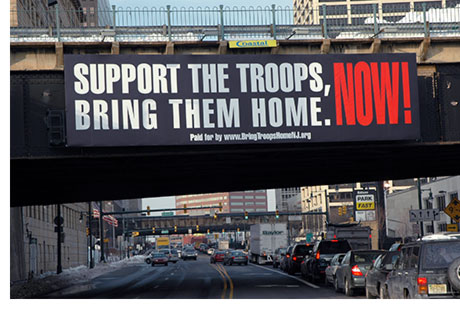
During the last month, as I have been driving to work in Newark, NJ, I've seen this billboard stretched across the road.


This message is the work of the folks at the NJ Coalition to Bring the Troops Home Now. It's a simple message, and one that's hard to argue with.

Check them out.

February 09, 2006

"Bring ‘Em Home"

Last night, there were two versions of that plea.

Version I – The short version -

At the Grammy Awards last night, Bruce Springsteen performed “Devils and Dust”. As recounted in a story in the Boston Globe -
Is Bruce Springsteen ever not riveting? His performance of "Devils and Dust" was classic, and very early Bob Dylan. Without so much as moving his hips, he generated intensity and spark, spitting out his lyrics so that we just had to hang on each line. ''And tonight faith just ain't enough," he sang, ending the song with a sober call: ''Bring 'em home."
Version II – The long version –

Some very dedicated individuals in my community hosted a forum last night, entitled “A Responsible Withdrawal from Iraq”. Among the speakers were the parents of a young man who has been mentioned here before – Edward August “Augie” Schroeder. His parents are taking a stand, and they are to be admired for that. The forum last night discussed the many plans out there to bring our troops home.

We should hope and pray that these pleas (the short and the long) are answered soon.

January 25, 2006

"Jumping The Shark"

That's the first thought that came to mind about "Wonkette.com", after reading this -
Hi. It’s Glenn Reynolds. I’m Wonkette for the day ...
No comment.

January 08, 2006

"We Keep Pretending That There's Nothing Wrong
But There's A Code Of Silence And It Can't Go On"

It's been on my mind for a while, which you may have gathered from the things I've posted here. I guess it started a couple of months ago, after I attended a talk by Scott Ritter. As I wrote at the time -
When asked what people should do, his answer was very simple - do something. Get out there. Make a statement. Don't wait for the Republicans, for the Democrats, for the New York Times, or for anyone else to talk straight. If more people did that, who knows what could happen?

Anyway, I bought a couple of copies of his new book (to read and to pass on), and took his admonition to heart. We all need to get out and make our voices heard - and no matter how many people we may reach, it helps to keep passing it on.
It continued when I reflected on the 30th anniversary of the death of John Lennon, and I had this thought -
We can let a performer (or any person) inspire us, but we can't let them be a replacement for us. If we just sit around remembering someone, who once sang "War is over, if you want it", and do nothing else, we're really not keeping him alive, are we?
Just the other day, I was moved by the words written by Mr. Paul Schroeder, who used to live, and who raised his late son (a Marine who died in Iraq), here in my community. He wrote at the conclusion of his essay:
But their deaths will not be in vain if Americans stop hiding behind flag-draped hero masks and stop whispering their opposition to this war. Until then, the lives of other sons, daughters, husbands, wives, fathers and mothers may be wasted as well.
In short, silence is not neutral, now. If you are not heard, you may as well be endorsing what is happening. I was reminded of that yet again today, reading a transcript of Howard Dean on CNN -
BLITZER: About a month ago, Senator Joe Lieberman, the former Democratic vice presidential nominee spoke out, urging his fellow Democrats, including yourself, to restrain themselves in criticizing the president's position on Iraq. Listen to what Lieberman said.

(BEGIN VIDEO CLIP)

SEN. JOSEPH LIEBERMAN (D), CONNECTICUT: It's time for Democrats who distrust President Bush to acknowledge that he will be the commander-in-chief for three more critical years, and that, in matters of war, we undermine presidential credibility at our nation's peril.

(END VIDEO CLIP)

BLITZER: What do you think? Is that advice good advice from Senator Lieberman?

DEAN: No. This president has lacked credibility almost from the day he took office because of the way he took office.

He's not reached out to other people. He's shown he's willing to abuse his power. He's not consulted others. And he's not interested in consulting any others.

And I think, frankly, that Joe is absolutely wrong, that it is incumbent on every American who is patriotic and cares about their country to stand up for what's right and not go along with the president, who is leading us in a wrong direction.
And, finally, this evening I found myself reading an address by Dr. Martin Luther King, Jr., delivered April 4, 1967 at a meeting of Clergy and Laity Concerned at Riverside Church in New York City, entitled "A Time to Break Silence". He was discussing the war in Vietnam, but his words are as applicable to our present times -
I come to this magnificent house of worship tonight because my conscience leaves me no other choice. I join you in this meeting because I am in deepest agreement with the aims and work of the organization which has brought us together: Clergy and Laymen Concerned about Vietnam. The recent statements of your executive committee are the sentiments of my own heart, and I found myself in full accord when I read its opening lines: "A time comes when silence is betrayal." And that time has come for us in relation to Vietnam.

The truth of these words is beyond doubt, but the mission to which they call us is a most difficult one. Even when pressed by the demands of inner truth, men do not easily assume the task of opposing their government's policy, especially in time of war. Nor does the human spirit move without great difficulty against all the apathy of conformist thought within one's own bosom and in the surrounding world. Moreover, when the issues at hand seem as perplexed as they often do in the case of this dreadful conflict, we are always on the verge of being mesmerized by uncertainty; but we must move on.

And some of us who have already begun to break the silence of the night have found that the calling to speak is often a vocation of agony, but we must speak. We must speak with all the humility that is appropriate to our limited vision, but we must speak. And we must rejoice as well, for surely this is the first time in our nation's history that a significant number of its religious leaders have chosen to move beyond the prophesying of smooth patriotism to the high grounds of a firm dissent based upon the mandates of conscience and the reading of history. Perhaps a new spirit is rising among us. If it is, let us trace its movements and pray that our own inner being may be sensitive to its guidance, for we are deeply in need of a new way beyond the darkness that seems so close around us.
(By the way, you can listen to that address at this link.)

So, to sum up - I feel that there are so many reminders out there that to be silent is to aquiesce. As I've said before, if you approve of what is happening, that is your right. If you do not, then you can't just sit there. Learn about what is going on, make a statement in some way, and contribute to the growing clamor.

You know what to do, so just go and do it.

January 07, 2006

"Well Brunettes Are Fine Man
And Blondes Are Fun ..."

We don't tell a lot of jokes around here, but this one (courtesy of The Lesser of Two Weevils), is clearly the funniest blonde joke ever.

(Apologies to the golden-haired among you, but sometimes I can't help myself)

January 03, 2006

A Prayer For The Souls Of The Departed

I've written here before about Edward August "Augie" Schroeder. He grew up in my community in New Jersey. He graduated from our high school in 2000; my own son graduated from that same school last year. I did not know him or his parents personally, but many of my friends and neighbors did. Like my own son, he was a Scout, a town pool lifeguard, took part in assorted extracurricular activities, and was active in his church's youth group. In his yearbook portrait (which you can see in the story at this link), he looks just like a lot of the kids of our friends, and like our childrens' classmates. Heck, my son has a similar haircut in his yearbook picture. A lot of us see our own children, when we look at his picture.

He died while riding in a lightly armored, amphibious vehicle in the middle of the desert.

At the time, we saw that his parents were very strong people, who were not afraid to make their feelings known - His father had asked a friend to pass this on to the community through a local internet message board: "Also, we want them to know that the question is not why, but what next."

Cpl. Schroeder's father has continued making his feelings known, and did so today in an essay published in the Washington Post (which you may have read already, since it's all over the web today):
Life, Wasted
Let's Stop This War Before More Heroes Are Killed

By Paul E. Schroeder

Tuesday, January 3, 2006; Page A17

Early on Aug. 3, 2005, we heard that 14 Marines had been killed in Haditha, Iraq. Our son, Lance Cpl. Edward "Augie" Schroeder II, was stationed there. At 10:45 a.m. two Marines showed up at our door. After collecting himself for what was clearly painful duty, the lieutenant colonel said, "Your son is a true American hero."

Since then, two reactions to Augie's death have compounded the sadness.

At times like this, people say, "He died a hero." I know this is meant with great sincerity. We appreciate the many condolences we have received and how helpful they have been. But when heard repeatedly, the phrases "he died a hero" or "he died a patriot" or "he died for his country" rub raw.

"People think that if they say that, somehow it makes it okay that he died," our daughter, Amanda, has said. "He was a hero before he died, not just because he went to Iraq. I was proud of him before, and being a patriot doesn't make his death okay. I'm glad he got so much respect at his funeral, but that didn't make it okay either."

The words "hero" and "patriot" focus on the death, not the life. They are a flag-draped mask covering the truth that few want to acknowledge openly: Death in battle is tragic no matter what the reasons for the war. The tragedy is the life that was lost, not the manner of death. Families of dead soldiers on both sides of the battle line know this. Those without family in the war don't appreciate the difference.

...

Two painful questions remain for all of us. Are the lives of Americans being killed in Iraq wasted? Are they dying in vain? President Bush says those who criticize staying the course are not honoring the dead. That is twisted logic: honor the fallen by killing another 2,000 troops in a broken policy?

...

But their deaths will not be in vain if Americans stop hiding behind flag-draped hero masks and stop whispering their opposition to this war. Until then, the lives of other sons, daughters, husbands, wives, fathers and mothers may be wasted as well.

This is very painful to acknowledge, and I have to live with it. So does President Bush.
As always, read the whole thing.

So, what more do we need to hear? It is no longer the case that "your silence passes as honor". If you agree that everything is just as it should be, then that is your right. But, if you do not agree, then you can't just sit there. We've been told what we have to do, so we had best start doing it.

This Pretty Well Sums It Up

An editorial in the current issue of the National Catholic Reporter -
Enough.

Little else is left to say to an administration that:

- Led a country into war on false premises;

- Continues to link the war against terrorism with the war in Iraq when the two had no relationship at the outset;

- Dismisses the Geneva Conventions and holds prisoners incognito for years, without charges or access to legal representation;

- Places detainees on planes bound for foreign countries known for torture and abuse of prisoners;

- Maintains secret CIA prisons on foreign soil;

- Subverts laws guarding the civil liberties of U.S. citizens, including searches of personal records and infiltration of religious and peace groups by the FBI;

- Defers to a vice president who argues for legal exceptions so that U.S. personnel can engage in torture;

- And has, at various times, created mechanisms to plant false news reports domestically and overseas and most recently paid to have stories planted in the Iraqi press.

Where are we headed?

To this deeply disturbing list of human rights abuses and violations of civil liberties add the most recent revelations that President Bush, under the influence of and with the encouragement of Vice President Cheney, personally approved widespread electronic eavesdropping on Americans.

We may not have reached, yet, the “Newspeak” or “telescreens” of 1984, but the level of deception is certainly approaching Orwellian dimensions when a president who casts himself as a champion of global democracy could orchestrate so much that is fundamentally destructive of democracy.

...

Bush tells us that he is protecting us from terrorists. But without even the minimal protection of the secret Federal Intelligence Surveillance Court, how do we know what criteria are used to determine national security threats? Who’s there to protect against the temptation to use the technology for political ends? Exactly what, in these days of secret detentions and rendition flights, makes for an enemy of the state?

At what point do we begin to call what’s happening a dangerous abuse of power and demand accountability?

It is time.
As always, read the rest for yourself.

January 02, 2006

Cautious Man

One of the reasons (and, there are a couple of them) that this collection of random thoughts takes its name from a particular song is the line –
When something caught his eye he'd measure his need
And then very carefully he'd proceed
So, if I have a New Years resolution, it is to be less, well, cautious in that regard. I’ve already started out on the wrong foot, since as you can see this isn’t being posted on January 1 (even though I thought about writing this on that day).

Basically, I have to improve my ratio of doing things to thinking about doing things. I have to remember that anything good that’s ever happened to me has been the result of overcoming my natural hesitation. If I hadn’t, I wouldn’t now be married to the Cautious Wife (yes, readers, “he let his cautiousness slip away”), or have any of the Cautious Kids, or be sitting right now in my nice home in my cool town. Listen, I agonized a long time over DSL vs. cable modem – that’s just the way I am. This whole site would’ve been operating a lot sooner if I hadn’t kept fussing with the color scheme (Hey, what's wrong with those colors? …).

We’ll see how it goes. Maybe if I let go of this obsessive need to try to use song lines for post titles, we might get more done here this year.

December 27, 2005

There’s An Opera Out On The Turnpike

In addition to "Born to Run", there's another piece of musical history celebrating its 30th anniversary -
I see a little silhouetto of a man
Scaramouch, scaramouch will you do the fandango
Thunderbolt and lightning - very very frightening me
Gallileo, Gallileo,
Gallileo, Gallileo,
Gallileo Figaro - magnifico

But I'm just a poor boy and nobody loves me
He's just a poor boy from a poor family
Spare him his life from this monstrosity

Easy come easy go - will you let me go
Bismillah! No - we will not let you go - let him go
Bismillah! We will not let you go - let him go
Bismillah! We will not let you go - let me go
Will not let you go - let me go
Never let you go - let me go
Never let me go - ooo
No, no, no, no, no, no, no -

Oh mama mia, mama mia, mama mia let me go
Beelzebub has a devil put aside for me
for me
for me
I made a number of people feel old today (including the Cautious Wife) when I told them about this.

What is it about this song? You feel that you should be embarrassed to admit that you enjoyed it (or, still enjoy it). Yes, it's probably meaningless, but what the heck, it was (is) still a lot of fun.

And what's wrong with that?

December 21, 2005

And A King Ain’t Satisfied
Till He Rules Everything

As you know (since you are reading a blog), the President has admitted that, despite what Federal law requires, he has issued orders for electronic surveillance of Americans in their communications with people outside of the country, with no warrant or other compliance with the Foreign Intelligence Surveillance Act (FISA). These are some of the ways he tried to explain himself at his Monday press conference -
As President and Commander-in-Chief, I have the constitutional responsibility and the constitutional authority to protect our country. Article II of the Constitution gives me that responsibility and the authority necessary to fulfill it. And after September the 11th, the United States Congress also granted me additional authority to use military force against al Qaeda.

After September the 11th, one question my administration had to answer was how, using the authorities I have, how do we effectively detect enemies hiding in our midst and prevent them from striking us again? We know that a two-minute phone conversation between somebody linked to al Qaeda here and an operative overseas could lead directly to the loss of thousands of lives. To save American lives, we must be able to act fast and to detect these conversations so we can prevent new attacks.

So, consistent with U.S. law and the Constitution, I authorized the interception of international communications of people with known links to al Qaeda and related terrorist organizations. This program is carefully reviewed approximately every 45 days to ensure it is being used properly. Leaders in the United States Congress have been briefed more than a dozen times on this program. And it has been effective in disrupting the enemy, while safeguarding our civil liberties.
...

THE PRESIDENT: I think I've got the authority to move forward, Kelly. I mean, this is what -- and the Attorney General was out briefing this morning about why it's legal to make the decisions I'm making. I can fully understand why members of Congress are expressing concerns about civil liberties. I know that. And it's -- I share the same concerns. I want to make sure the American people understand, however, that we have an obligation to protect you, and we're doing that and, at the same time, protecting your civil liberties.

Secondly, an open debate about law would say to the enemy, here is what we're going to do. And this is an enemy which adjusts. We monitor this program carefully. We have consulted with members of the Congress over a dozen times. We are constantly reviewing the program. Those of us who review the program have a duty to uphold the laws of the United States, and we take that duty very seriously.
...

Q Thank you, Mr. President. Getting back to the domestic spying issue for a moment. According to FISA's own records, it's received nearly 19,000 requests for wiretaps or search warrants since 1979, rejected just five of them. It also operates in secret, so security shouldn't be a concern, and it can be applied retroactively. Given such a powerful tool of law enforcement is at your disposal, sir, why did you see fit to sidetrack that process?

THE PRESIDENT: We used the process to monitor. But also, this is a different -- a different era, a different war, Stretch. So what we're -- people are changing phone numbers and phone calls, and they're moving quick. And we've got to be able to detect and prevent. I keep saying that, but this is a -- it requires quick action.

And without revealing the operating details of our program, I just want to assure the American people that, one, I've got the authority to do this; two, it is a necessary part of my job to protect you; and, three, we're guarding your civil liberties. And we're guarding the civil liberties by monitoring the program on a regular basis, by having the folks at NSA, the legal team, as well as the inspector general, monitor the program, and we're briefing Congress. This is a part of our effort to protect the American people. The American people expect us to protect them and protect their civil liberties. I'm going to do that. That's my job, and I'm going to continue doing my job.
...

Q Thank you, Mr. President. I wonder if you can tell us today, sir, what, if any, limits you believe there are or should be on the powers of a President during a war, at wartime? And if the global war on terror is going to last for decades, as has been forecast, does that mean that we're going to see, therefore, a more or less permanent expansion of the unchecked power of the executive in American society?

THE PRESIDENT: First of all, I disagree with your assertion of "unchecked power."

Q Well --

THE PRESIDENT: Hold on a second, please. There is the check of people being sworn to uphold the law, for starters. There is oversight. We're talking to Congress all the time, and on this program, to suggest there's unchecked power is not listening to what I'm telling you. I'm telling you, we have briefed the United States Congress on this program a dozen times.

This is an awesome responsibility to make decisions on behalf of the American people, and I understand that, Peter. And we'll continue to work with the Congress, as well as people within our own administration, to constantly monitor programs such as the one I described to you, to make sure that we're protecting the civil liberties of the United States. To say "unchecked power" basically is ascribing some kind of dictatorial position to the President, which I strongly reject.

Q What limits do you --

THE PRESIDENT: I just described limits on this particular program, Peter. And that's what's important for the American people to understand. I am doing what you expect me to do, and at the same time, safeguarding the civil liberties of the country.
At no point is a judge mentioned, in this process. There's a reason for that - the Administration apparently decided that they did not need judges, or warrants, or any other procedures specifically called for in the law. FISA allows warrantless interceptions of communications, but only if they involve foreigners or foreign governments, and only if it is clear that people in America will not be the subject of the communication.

As Steven Hart has pointed out, this incident may be separating the "real" conservatives from those he calls the "royalists" (who apparently support everything and anything the current President decides to do). One of the "non-royalist" or "real" conservatives noted by Mr. Hart is Bruce Fein, a former Reagan administration official, who wrote the following -
According to President George W. Bush, being president in wartime means never having to concede co-equal branches of government have a role when it comes to hidden encroachments on civil liberties.
...

Authorized after the September 11, 2001 abominations, the eavesdropping clashes with the Foreign Intelligence Surveillance Act (FISA), excludes judicial or legislative oversight, and circumvented public accountability for four years until disclosed by the New York Times last Friday. Mr. Bush's defense generally echoed previous outlandish assertions that the commander in chief enjoys inherent constitutional power to ignore customary congressional, judicial or public checks on executive tyranny under the banner of defeating international terrorism, for example, defying treaty or statutory prohibitions on torture or indefinitely detaining United States citizens as illegal combatants on the president's say-so.

President Bush presents a clear and present danger to the rule of law. He cannot be trusted to conduct the war against global terrorism with a decent respect for civil liberties and checks against executive abuses. Congress should swiftly enact a code that would require Mr. Bush to obtain legislative consent for every counterterrorism measure that would materially impair individual freedoms.
...

The NSA eavesdropping is further troublesome because it easily evades judicial review. Targeted citizens are never informed their international communications have been intercepted. Unless a criminal prosecution is forthcoming (which seems unlikely), the citizen has no forum to test the government's claim the interceptions were triggered by known links to a terrorist organization.

Mr. Bush acclaimed the secret surveillance as "crucial to our national security. Its purpose is to detect and prevent terrorist attacks against the United States, our friends and allies." But if that were justified, why was Congress not asked for legislative authorization in light of the legal cloud created by FISA and the legislative branch's sympathies shown in the Patriot Act and joint resolution for war? FISA requires court approval for national security wiretaps, and makes it a crime for a person to intentionally engage "in electronic surveillance under color of law, except as authorized by statute."

Mr. Bush cited the disruptions of "terrorist" cells in New York, Oregon, Virginia, California, Texas and Ohio as evidence of a pronounced domestic threat that compelled unilateral and secret action. But he failed to demonstrate those cells could not have been equally penetrated with customary legislative and judicial checks on executive overreaching.

The president maintained that, "As a result [of the NSA disclosure], our enemies have learned information they should not have, and the unauthorized disclosure of this effort damages our national security and puts our citizens at risk." But if secrecy were pivotal to the NSA's surveillance, why is the president continuing the eavesdropping? And why is he so carefree about risking the liberties of both the living and those yet to be born by flouting the Constitution's separation of powers and conflating constructive criticism with treason?

And by the way, Mr. Fein is a man of strong opinions with respect to Presidential misconduct. This is what he had to say in 1997, regarding then-President Clinton's fundraising activities -
President Clinton's conceded shameless and calculated exploitation of the White House to extract, entice or reward partisan political contributions is an impeachable offense under Article II, Section 4 of the U.S. Constitution.

House Judiciary Committee Chairman Henry Hyde of Illinois should commence an impeachment inquiry aimed toward indicting the president for the "high misdemeanor" of gross betrayal of the public trust by systematically employing the perquisites of office (and perhaps prerogatives over foreign policy toward China) for private financial advantage.

The architects of the Constitution were masters of human nature and history. They understood the propensity of the powerful, especially a chief executive, to circumvent the law or to wield official discretion in ways that dangerously subvert public confidence in the integrity and legitimacy of government.
...

In other words, impeachable offenses were envisioned as political crimes against the nation, which might or might not be indictable under the criminal code. The House Judiciary Committee voted articles of impeachment against President Nixon, but his unprecedented resignation ended any further proceedings. The vast scholarly and political debate that emerged from the Nixon impeachment proceedings yielded an overwhelming consensus that removal of a president from office would be proper for grave political misconduct (not mere foibles) that tears at the social tapestry of trust, honor and fairness.

So, to sum up. If one is of the view that circumventing a clear law, in order to engage in secret surveillance and searches of Americans, is a "grave ... misconduct ... that tears at the social tapestry of trust, honor and fairness", what's the next step?

December 15, 2005

Merry Christmas, Baby

I have been reluctant to post about the so-called "War on Christmas". That's the phony controversy that Bill O'Reilly, John Gibson, and those other folks at the Fox Bigotry Channel (FBC) are thumping this year, with the help of some of the usual suspects.

It's depressing, actually. These folks want to make a buck, so they have found a way to make people angry, just because some innocent and friendly clerk in a store says "Happy Holidays". In so doing, they are just trying to suck a little joy out of the season - as if what happens at the mall is actually important.

Well, as Charlie Brown says in my favorite Christmas special of all time, "I'm not going to let all this commercialism ruin my Christmas!" And, to the rescue, comes Representative John Dingell, who provided the following today on the floor of the House of Representatives, in response to some resolution proposed in order to capitalize on the hatemongering from the aforementioned FBC -
Congressman John D. Dingell (MI-15) recited the following poem on the floor of the US House of Representatives concerning House Resolution 579, which expressed the sense of the House of Representatives that the symbols and traditions of Christmas should be protected. “Preserving Christmas” has been a frequent topic for conservative talk show hosts, including Fox News’s Bill O’Reilly:

'Twas the week before Christmas and all through the House,
no bills were passed `bout which Fox News could grouse.
Tax cuts for the wealthy were passed with great cheer,
so vacations in St. Barts soon should be near.

Katrina kids were all nestled snug in motel beds,
while visions of school and home danced in their heads.
In Iraq, our soldiers need supplies and a plan,
and nuclear weapons are being built in Iran.

Gas prices shot up, consumer confidence fell.
Americans feared we were in a fast track to ..... well.
Wait, we need a distraction, something divisive and wily,
a fabrication straight from the mouth of O'Reilly.

We will pretend Christmas is under attack,
hold a vote to save it, then pat ourselves on the back.
Silent Night, First Noel, Away in the Manger,
Wake up Congress, they're in no danger.

This time of year, we see Christmas everywhere we go,
From churches to homes to schools and, yes, even Costco.
What we have is an attempt to divide and destroy
when this is the season to unite us with joy.

At Christmastime, we're taught to unite.
We don't need a made-up reason to fight.
So on O'Reilly, on Hannity, on Coulter and those right-wing blogs.
You should sit back and relax, have a few egg nogs.

'Tis the holiday season; enjoy it a pinch.
With all our real problems, do we really need another Grinch?
So to my friends and my colleagues, I say with delight,
a Merry Christmas to all, and to Bill O'Reilly, happy holidays
And yes, the last line is my favorite.

(Found on Demagogue via Atrios)

December 11, 2005

"I Can't Seem To Find My Way Back To The Wood"

There's nothing like having an international mega-corporation do something that makes me sound like an old fart, but here goes anyway ...

"What the heck is the matter with you people?"
Maybe it's just the impossibly cozy nature of the 'hood, but for 80 years there has been no change in the resident line-up of the Hundred Acre Wood.

Guess who's coming for honey? As part of a barrel-full of Winnie the Pooh anniversary events, Disney is working on a new animated series that will replace Christopher Robin with a 6-year-old girl.

To quote one loquacious Rabbit: "Oh my, oh my, oh my goodness!"

Although the bear's party fare includes much Disney hoopla — anniversary-themed goods, Disney Channel marathons and a stage show that kicks off today in New York — the real bother is sure to be over tinkering with a classic.

Details are sketchy on the as-yet-nameless new arrival, who will make her debut in the 2007 computer-generated series My Friends Tigger and Pooh. Disney execs say the idea is to bring an older audience to an iconic franchise born when British author A.A. Milne began musing about the imaginary world of his son, Christopher Robin.

"We got raised eyebrows even in-house at first, but the feeling was these timeless characters really needed a breath of fresh air that only the introduction of someone new could provide," says Nancy Kanter of the Disney Channel.
This is from a news release from folks who (unlike others) are proud to say that they are from Mickey Mouse News.

I'm sorry, but I cannot fathom a mindset which reaches the conclusion that "timeless characters" are something which "needed a breath of fresh air".

Here's a little news for the folks at the Mouse Factory (who through cruel fate are the custodians of all that is Pooh) - the stories are constantly new. There are always new children to sit on someone's lap, and open a book, and begin to read -
HERE is Edward Bear, coming downstairs now, bump, bump, bump, on the back of his head, behind Christopher Robin. It is, as far as he knows, the only way of coming downstairs, but sometimes he feels that there really is another way, if only he could stop bumping for a moment and think of it.

And then he feels that perhaps there isn't. Anyhow, here he is at the bottom, and ready to be introduced to you. Winnie-the-Pooh.

When I first heard his name, I said, just as you are going to say, "But I thought he was a boy?"
"So did I," said Christopher Robin.
"Then you can't call him Winnie?"
"I don't."
"But you said--"
"He's Winnie-ther-Pooh. Don't you know what 'ther' means?"
"Ah, yes, now I do," I said quickly; and I hope you do too, because it is all the explanation you are going to get.
Sometimes Winnie-the-Pooh likes a game of some sort when he comes downstairs, and sometimes he likes to sit quietly in front of the fire and listen to a story. This evening--
"What about a story?" said Christopher Robin.
"What about a story?" I said.
"Could you very sweetly tell Winnie-the-Pooh one?"
"I suppose I could," I said. "What sort of stories does he like?"
"About himself. Because he's that sort of Bear."
"Oh, I see."
"So could you very sweetly?"
"I'll try," I said.
So I tried.

Once upon a time, a very long time ago now, about last Friday, Winnie-the-Pooh lived in a forest all by himself under the name of Sanders.
...
Well, you get the idea.

And the point, in case you still don't realize it, is that these "timeless characters" are either (a) brand new to the kids who discover them (or, more likely, who their parents share them with) or (b) comforting and familiar memories for old farts. The folks at Disney have to realize that if they feel the need to make new animated features, they have to maintain some shred of a connection to the original. Not every kid is lucky enough to meet Winnie, Piglet, Owl, Eeyore, etc. for the first time in a book. And I don't know why anyone would do something to cause a child to look up at his parent, and say, "Who's that kid Christopher Robin in this book? Where's that little girl who was in the cartoon?"

I'd hate to think that Disney would embark on a plan to create a generation of kids who would not grow up to know the meaning of this song (Oh, click the link before reading further, and turn your sound up) -
Christopher Robin and I walked alone
Under branches lit up by the moon
Posing our questions to Owl and Eeyore
As our days disappeared far too soon
But I've wandered much further today than I should
And I can't seem to find my way back to the woods

So help me if you can, I've got to get
Back to the house at Pooh Corner by one
You'd be surprised, there's so much to be done
Count all the bees in the hive
Chase all the clouds from the sky
Back to the days of Christopher Robin
...And Pooh.

December 08, 2005

"But Saviors Don't Last Long ..."

Twenty-five years ago tonight, I came back from studying, to my apartment on campus, where my roommates were watching "Monday Night Football." And, they told me.

This is the song that's been in my head all day -
Words are flowing out like endless rain into a paper cup,
They slither while they pass, they slip away Across the Universe.
Pools of sorrow, waves of joy are drifting through my opened mind,
Possessing and caressing me.

Images of broken light which dance before me like a million eyes,
They call me on and on Across the Universe.
Thoughts meander like a restless wind inside a letter box,
They tumble blindly as they make their way Across the Universe

Sounds of laughter, shades of earth are ringing
Through my open ears inciting and inviting me.
Limitless, undying love, which shines around me like a million suns,
And calls me on and on Across the Universe

Jai Guru Deva Om
Nothing's gonna change my world
I always thought "classic" recorded version was too too over-wrought, but the words still came through, and that’s why I think it stands out among the Beatles' songs.

Today, a lot of people are reflecting about something and someone lost - but what can you do? I don't think endless re-playings of "Imagine" are as applicable today, at least if you listen to the lyrics. For each of us, in different ways, people live on. Knowing that, our job is to figure out what to do with ourselves.

What's with the title of this post, you ask? It's from a song I heard performed for the first time just two weeks ago, at the last Springsteen solo show (oh, come on, it's okay to mention him in this post). It's an old lyric, last performed decades ago, that I previously knew only in written form. I thought of it today, also, in reflecting about how much, of ourselves, we invest in our performers -
The lost souls search for saviors
But saviours don't last long
Those aimless, questionless renegade brats
Who live their lives in songs
They run the length of a candle
In a goodnight whisper and a puff they're gone
We can let a performer (or any person) inspire us, but we can't let them be a replacement for us. If we just sit around remembering someone, who once sang "War is over, if you want it", and do nothing else, we're really not keeping him alive, are we?

December 04, 2005

Really Random Thoughts

First off - what is the big deal with this Jennifer Anniston thing? Her husband apparently chose a "simpler" way to go - too bad for him. Among the choices we make in life, he chose poorly. The Cautious Man is spoken for, but I tip my hat to the dude who steps up.

Another random thought - I saw a Springsteen calendar today as I trudged through my Christmas shopping. Seriously, even I would not purchase this item, because while I have a deep respect and affinity for the man's music, I do not need multiple pictures of him on my wall as a result.

November 17, 2005

Good Rockin' Tonight

The staff here at A Cautious Man had a great time tonight, and last night too, at Bruce Springsteen's solo performances here in New Jersey. Tonight's show was the first time we ever heard the song that inspired our title performed live. Thanks to Dave for needing someone to tag along to the show tonight.

November 16, 2005

Armchair Warriors Often Fail

Senator Chuck Hagel of Nebraska (decorated Viet Nam veteran) once again is showing that not all Republicans are completely in the tank for the Administration and its war policy. He gave quite the speech yesterday at the Council on Foreign Relations. While most people may focus on his direct rebuttal, of the President’s attempt to insulate himself from criticism about Iraq, Senator Hagel also had some interesting things to say about the issue of a President’s war powers, and about who should decide to send troops into a war.

But first, the pointed reply to the theme of the “It’s Not My Fault Tour” -
The Iraq war should not be debated in the United States on a partisan political platform. This debases our country, trivializes the seriousness of war and cheapens the service and sacrifices of our men and women in uniform. War is not a Republican or Democrat issue. The casualties of war are from both parties. The Bush Administration must understand that each American has a right to question our policies in Iraq and should not be demonized for disagreeing with them. Suggesting that to challenge or criticize policy is undermining and hurting our troops is not democracy nor what this country has stood for, for over 200 years. The Democrats have an obligation to challenge in a serious and responsible manner, offering solutions and alternatives to the Administration’s policies.

Vietnam was a national tragedy partly because Members of Congress failed their country, remained silent and lacked the courage to challenge the Administrations in power until it was too late. Some of us who went through that nightmare have an obligation to the 58,000 Americans who died in Vietnam to not let that happen again. To question your government is not unpatriotic – to not question your government is unpatriotic. America owes its men and women in uniform a policy worthy of their sacrifices.

Today, the Senate engaged in a legitimate debate over exit strategy in Iraq as the Senate considered and voted on two Senate resolutions. This is a significant step toward the Congress exercising its Constitutional responsibilities over matters of war.
Senator Hagel continues, later in the speech, to address the issue of Congress’ “Constitutional responsibilities over matters of war” -
The Constitution also establishes Congress’ authority and responsibility regarding decisions to go to war. The course of events in Iraq has laid bare the failure to prepare for, plan for, and understand the broad consequences and implications of the decision to overthrow Saddam Hussein and occupy Iraq. Where is the accountability? In the November 8 Washington Post, Leslie Gelb, President Emeritus of the Council on Foreign Relations, and Anne-Marie Slaughter, Dean of the Woodrow Wilson School at Princeton University, wrote,

"Our Founding Fathers wanted the declaration of war to concentrate the minds. Returning to the Constitution’s text and making it work through legislation requiring joint deliberate action may be the only way to give the decision to make war the care it deserves."

The American people should demand that the President request a Declaration of War and the Congress formally declare war, if and when the President believes that committing American troops is in the vital national security interests of this country. This would make the President and Congress, together, accountable for their actions – just as the Founders of our country intended.
I think that’s powerful stuff. One of the issues the Iraq conflict has raised is, once again, that of the power to make war, and to decide to go to war. If a President were to have the same point of view as Senator Hagel, there could be a serious, and overdue, examination of a President’s assertion to unilaterally initiate a war.

One more thing, just to flash back, Senator Hagel also seemed to be one of the few Republicans who was talking sense on the eve of the Iraq invasion, back in February of 2003 -
Today, America stands nearly alone in proclaiming the urgency of the use of force to disarm Saddam Hussein. In Europe and in many corners of the globe, America is perceived as determined to use force in Iraq to the exclusion of world opinion or the interests of our allies, even those allies who share our concerns about Saddam Hussein's weapons programs. America must balance its determination with patience and not be seen as in a rush to war. As David Ignatius wrote in a recent Washington Post column, "A nation heading into war needs prudence and good judgment. America's best generals, people such as Grant and Marshall and Eisenhower, were at once cautious and decisive. Their greatness lay in the fact that they never lost sight of the long-term interests of the United States."

America must steer away from actions that could produce the unintended results of fracturing those very institutions that have helped keep peace since World War II. Allowing a rush to war in Iraq to create divisions in those institutions and alliances that will help sustain American security and world stability is a short-sighted and dangerous course of action.


We should put aside the mistaken delusion that democracy is just around the corner. Or that by force of arms we can remove Saddam and simultaneously place Iraq on the path to democracy by overlaying a blueprint for democracy on the region ... a so-called "Democratic Domino Effect." The spade work of building a free Iraq will take time. General Anthony Zinni, special adviser to the Secretary of State and former Commanding General, U.S. Central Command, reminded the Senate Foreign Relations Committee last week that, with regard to Iraq, "there will not be a spontaneous democracy so the reconstruction of the country will be a long, hard course regardless of whether a modest vision of the end state is sought or a more ambitious one is chosen." The end of Saddam Hussein's regime will be all to the good, but building nations and democracy in the Middle East or anywhere is complicated and difficult, and success is never assured. We can try to help create the conditions for democratic change. But we must assume that it will not come quickly or easily.
I think we’ve forgotten that there was bipartisan unease with the President’s eagerness to initiate an invasion. “Everybody” may have been worried about Saddam Hussein, but not “everybody” felt that an immediate invasion was necessarily the right cure.

And that’s the point of the criticism, of how America got into this war.

November 15, 2005

"The American Way So That Truth Will Out"

The discussion continues, about who may have been a little too aggressive when trying to get the Iraq invasion to happen. A lot of people are writing much more informative things about President Bush’s current “It’s Not My Fault Tour – 2005”. This is my two cents’ worth.

Yesterday, the President gave another speech, on a military base in Alaska, attacking his critics. He’s revisiting old lines from past speeches, poor guy – he really needs a new writer. Interestingly enough, as he travels around arguing that people are rewriting history by claiming that he was misleading people about Iraq – he’s, well, rewriting history and misleading people. For example, this is how he describes the start of the war -
After more than a decade of diplomacy, we gave Saddam Hussein a final chance to comply with the United Nations Security Council resolutions, ordering him to disclose, disarm, or face serious consequences. When he refused, we had a choice: Do we take the word of a madman and forget the lessons of September the 11th, or do we take action to defend our country? Given that choice, I will defend America every time.
As pointed out here before, the reason the U.N. weapons inspectors ultimately left Iraq was that President Bush was about to launch a war to, well, enforce the inspections (or something like that). As reported by Fox News on the eve of war -
U.N. weapons inspectors climbed aboard a plane and pulled out of Iraq on Tuesday after President Bush issued a final ultimatum for Saddam Hussein to step down or face war. U.N. Secretary-General Kofi Annan on Monday ordered all U.N. inspectors and support staff, humanitarian workers and U.N. observers along the Iraq-Kuwait border to evacuate Iraq after U.S. threats to launch war.

After failing to secure U.N. authorization to use force to disarm Iraq, Bush gave Saddam 48 hours to step down or face war in a speech Monday night.


U.N. weapons inspectors arrived in Baghdad for the first time in four years on Nov. 27, 2002, and resumed inspections two days later. During four months of inspections, arms experts traveled the length of the country hunting for banned weapons of mass destruction.

Chief U.N. weapons inspector Hans Blix has said that during those inspections, inspectors never found any "smoking gun."
At another point in his speech yesterday, the President said he can respect those who disagreed with him all along, and decried those whom he said were playing politics with the war -
Some of our elected leaders have opposed this war all along. I disagreed with them, but I respect their willingness to take a consistent stand. Yet some Democrats who voted to authorize the use of force are now rewriting the past. They are playing politics with this issue and they are sending mixed signals to our troops and the enemy. And that's irresponsible.
As has also been discussed here before, the President did not have that same respect for different opinions, and he played politics with war, when he was trying to badger the Congress into giving him authority to invade, if he so chose. As he said in response to a question in September of 2002 -
Q Mr. President, thank you. Are you concerned that Democrats in Congress don't want a vote there until after U.N. action? …

THE PRESIDENT: … And the first part of the question was, Democrats waiting for the U.N. to act? I can't imagine an elected United States -- elected member of the United States Senate or House of Representatives saying, I think I'm going to wait for the United Nations to make a decision. It seems like to me that if you're representing the United States, you ought to be making a decision on what's best for the United States. If I were running for office, I'm not sure how I'd explain to the American people -- say, vote for me, and, oh, by the way, on a matter of national security, I think I'm going to wait for somebody else to act.

And so I -- we'll see. My answer to the Congress is, they need to debate this issue and consult with us, and get the issue done as quickly as possible. It's in our national interests that we do so. I don't imagine Saddam Hussein sitting around, saying, gosh, I think I'm going to wait for some resolution. He's a threat that we must deal with as quickly as possible.
So, let’s re-cap. The inspectors were in Iraq, and the President decided to invade anyway, based on a resolution which he obtained from Congress in the middle of the 2002 elections. Yesterday, the President repeated that his decision to invade was authorized by that Congressional action -
Reasonable people can disagree about the conduct of the war, but it is irresponsible for Democrats to now claim that we misled them and the American people. Leaders in my administration and members of the United States Congress from both political parties looked at the same intelligence on Iraq, and reached the same conclusion: Saddam Hussein was a threat.
But, the decision to invade, even though there were inspectors on the ground in Iraq, was the President’s alone. The Congress was irresponsible in giving him the authority to make that final decision to go to war, requiring only that he send a letter saying that he thought it was necessary to invade -
March 18, 2003

Dear Mr. Speaker: (Dear Mr. President:)

Consistent with section 3(b) of the Authorization for Use of Military Force Against Iraq Resolution of 2002 (Public Law 107-243), and based on information available to me, including that in the enclosed document, I determine that:

(1) reliance by the United States on further diplomatic and other peaceful means alone will neither (A) adequately protect the national security of the United States against the continuing threat posed by Iraq nor (B) likely lead to enforcement of all relevant United Nations Security Council resolutions regarding Iraq; and

(2) acting pursuant to the Constitution and Public Law 107-243 is consistent with the United States and other countries continuing to take the necessary actions against international terrorists and terrorist organizations, including those nations, organizations, or persons who planned, authorized, committed, or aided the terrorist attacks that occurred on September 11, 2001.

Sincerely,

GEORGE W. BUSH
Did you catch that? The President said based on information available to him, only some of which he provided to Congress, it was time to invade. And, we all know how true either (1) or (2) turned out to be.

So, should everyone say, "Okay, Mr. President, we'll stop asking questions"? Don't think so. As noted here before, maybe the best response to anyone, who opposes looking into how America stumbled into this war, is a statement from Mr. Springsteen on his tour a couple of years ago -
"The question of whether we were misled in the war with Iraq is neither a liberal or conservative question or Democratic or Republican question. It's an American question. And protecting the democracy we ask our sons and daughters to die for is our responsibility and it's our trust. And demanding accountability is our job as citizens. That's the American way so that truth will out."

October 30, 2005

"I Woke Up Last Night Shaking From A Dream
For In That Dream I Died"

Before we move too far down the road discussing the indictments of high government officials, the mishandling of the war and the weather, or even a new Supreme Court nominee, let's take a moment to feel a little sorry for Harriet Miers. How must it feel, to know that when you come to the end of a hopefully long and productive life, the headline on your obituary will be - "Withdrew Nomination for Supreme Court". Your whole life, reduced to that one time you were on the wrong side of a political scrum ...

Even though she is a top White House official, she's really a victim of the drive-by governing style of the President. Face it, she was done in by the "conservatives" who didn't think she was enough of a firebrand. The Administration went ahead without gathering all the facts, without checking with the experts, and blindly ignoring the warning signs. Sound familiar?

Of course, as the "Plamegate" story reminds us, there are other victims of the Administration, some deliberately so. We're all interested in hearing why it was so important to destroy the career of a CIA operative, just to do political damage control. And to what end, to defend or to conceal how the Iraq War was initiated?

Having started this particular random thought, I realize that while Ms. Miers has definitely had a bad week, she'll get over it. After all, the publication of her obituary remains in the far future. On the other hand, there have been thousands of obituaries already published, of other victims of the deliberately ignorant (at best) and/or coldly venal (at worst) decision-making at the White House.

October 29, 2005

Bad Scooter Searching For His Groove

If anyone tells you that the indictment of I. Lewis "Scooter" Libby is nothing, because he was not indicted for disclosing that Valerie Plame Wilson was a CIA officer, tell them to pay attention to what United States Attorney Patrick Fitzgerald had to say yesterday. First, it seems that "Scooter" himself thought that he had done something wrong, because he made up stories to deflect attention from himself, to blame other people, and to keep from disclosing that he had aggressively been "outing" Ms. Plame. He wove an elaborate tale, and he told it again and again, even under oath -
When it was clear that Valerie Wilson's cover had been blown, investigation began. And in October 2003, the FBI interviewed Mr. Libby. Mr. Libby is the vice president's chief of staff. He's also an assistant to the president and an assistant to the vice president for national security affairs.

The focus of the interview was what it that he had known about Wilson's wife, Valerie Wilson, what he knew about Ms. Wilson, what he said to people, why he said it, and how he learned it.

And to be frank, Mr. Libby gave the FBI a compelling story.

What he told the FBI is that essentially he was at the end of a long chain of phone calls. He spoke to reporter Tim Russert, and during the conversation Mr. Russert told him that, Hey, do you know that all the reporters know that Mr. Wilson's wife works at the CIA?

And he told the FBI that he learned that information as if it were new, and it struck him. So he took this information from Mr. Russert and later on he passed it on to other reporters, including reporter Matthew Cooper of Time magazine, reporter Judith Miller of the New York Times.

And he told the FBI that when he passed the information on on July 12th, 2003, two days before Mr. Novak's column, that he passed it on understanding that this was information he had gotten from a reporter; that he didn't even know if it was true.

And he told the FBI that when he passed the information on to the reporters he made clear that he did know if this were true. This was something that all the reporters were saying and, in fact, he just didn't know and he wanted to be clear about it.

Later, Mr. Libby went before the grand jury on two occasions in March of 2004. He took and oath and he testified. And he essentially said the same thing.

He said that, in fact, he had learned from the vice president earlier in June 2003 information about Wilson's wife, but he had forgotten it, and that when he learned the information from Mr. Russert during this phone call he learned it as if it were new.

When he passed the information on to reporters Cooper and Miller late in the week, he passed it on thinking it was just information he received from reporters; that he told reporters that, in fact, he didn't even know if it were true. He was just passing gossip from one reporter to another at the long end of a chain of phone calls.

It would be a compelling story that will lead the FBI to go away if only it were true. It is not true, according to the indictment.

In fact, Mr. Libby discussed the information about Valerie Wilson at least half a dozen times before this conversation with Mr. Russert ever took place, not to mention that when he spoke to Mr. Russert, Mr. Russert and he never discussed Valerie Wilson or Wilson's wife.
Now, you may ask, even if he was not indicted under the strict standards of the law against outing a covert agent, did Mr. Libby actually do something wrong? Again, listen to Mr. Fitzgerald -
Valerie Wilson was a CIA officer. In July 2003, the fact that Valerie Wilson was a CIA officer was classified. Not only was it classified, but it was not widely known outside the intelligence community.

Valerie Wilson's friends, neighbors, college classmates had no idea she had another life.

The fact that she was a CIA officer was not well- known, for her protection or for the benefit of all us. It's important that a CIA officer's identity be protected, that it be protected not just for the officer, but for the nation's security.

Valerie Wilson's cover was blown in July 2003. The first sign of that cover being blown was when Mr. Novak published a column on July 14th, 2003.

But Mr. Novak was not the first reporter to be told that Wilson's wife, Valerie Wilson, Ambassador Wilson's wife Valerie, worked at the CIA. Several other reporters were told.

In fact, Mr. Libby was the first official known to have told a reporter when he talked to Judith Miller in June of 2003 about Valerie Wilson.

...

I can say that for the people who work at the CIA and work at other places, they have to expect that when they do their jobs that classified information will be protected. And they have to expect that when they do their jobs, that information about whether or not they are affiliated with the CIA will be protected.

And they run a risk when they work for the CIA that something bad could happen to them, but they have to make sure that they don't run the risk that something bad is going to happen to them from something done by their own fellow government employees.
...

I will say this: To the CIA people who are going out at a time that we need more human intelligence, I think everyone agrees with that, at a time when we need our spy agencies to have people work there, I think just the notion that someone's identity could be compromised lightly, to me compromises the ability to recruit people and say, Come work for us, come work for the government, come be trained, come invest your time, come work anonymously here or wherever else, go do jobs for the benefit of the country for which people will not thank you, because they will not know, they need to know that we will not cast their anonymity aside lightly.
Come to think of it, is it really so surprising that an Administration official would violate the secrecy of a CIA officer, and lie about it? These people thought nothing of making things up, in order to precipitate a war in which thousands of Americans, and tens of thousands of Iraqis, have lost their lives. What's one more little fib?

To read Mr. Fitzgerald's full remarks, look here (Link to NY Times; you can log in as "Cautiousman" with the password "Cautious").

October 25, 2005

Just Another Roll of the Dice

He’s been a losing gambler, just throwing snake eyes. Sitting at the craps table of the Iraq Casino for over two and a half years. Every day, every month, every year he tosses more and more bloody chips onto the table. But all of his elevens and sevens have been coming up sixes and nines. And as of today the house has collected 2000 of those chips, and they’re not coming back.

And what lesson has he learned?In other words, it’s never too late, America. Come on, the tables are waiting.

He tells us that we can win it all back, if we just keep on throwing down. You may think that this is classic addictive behavior, to continue on as the losses mount up, but of course he disagrees. He tells us that everything that we’ve lost so far will have been in vain, if we don’t keep putting more chips down onto the blood-soaked felt of this craps table. Every one of those chips is a person, with a family, but we can't pay attention to that now. We’re playing for all of the stakes, so all you high-rollers lay down your bets, and he’ll raise them.

Just another roll of the dice.

October 17, 2005

If there’s something you need
That you just don’t have
Well just don’t sit there
Feeling bad

Okay, so I haven't posted a lot, lately. I've thought of a lot of clever, insightful, and interesting things to say (trust me on this), but I just haven't put fingers to keyboard that much.

So, today, I was chided by not one, but two different people, about the fact that if I have something to say, I better get up and say it. One told me directly, both electronically and in person. The other didn't say it to me personally, but told those of us who attended his talk this evening about the importance of getting up and speaking out.

The first is the Curmudgeon, whose reappearance I noted in my last post. That would be, that last post I made nearly three weeks ago. So, maybe he had a point when he visited the comments section of that last post and wrote: "What - I'm back, so you've taken a powder?" He repeated his chiding in person this evening, when we both attended a talk in our town, by Scott Ritter. That's the same Scott Ritter who was described as follows in a Time Magazine profile in September of 2002 (remember 'way back then?) -

Never mind the naysaying European heads of state, the anxious Arab leaders or the skeptical senators — the unkindest challenge to President Bush's plans to take out Saddam Hussein this week came from erstwhile true-blue American hero Scott Ritter. Familiar to Americans as the rock-jawed Marine intelligence officer who stood up to Saddam's bullies in 1998 while serving with the UN inspection team, and got himself singled out for expulsion even before UNSCOM was withdrawn, Ritter was back on America's TV screens this week, but with a dramatically different message: President Bush had no proof of any new weapons of mass destruction threat emanating from Iraq, Ritter says, and he was lying to the American people to get them to go to war. Once a favorite guest of hawkish Republicans who regularly invited him to testify at congressional committees about the dangers of turning a blind eye to Iraq's weapons programs, this week Ritter was instead addressing the Iraqi legislature, decrying his own country's claims — and warning that readmitting inspectors was the only way to avoid a war.
Mr. Ritter's talk did not just focus on the past, but he did point out that we have to learn from those mistakes of the past, in order to have a cear-eyed view of how to deal with the mess created by the Iraq invasion.

As part of that talk, he made it clear how important it is that we make our voices heard. After hearing him speak, I realize that there's nothing like having a complete grasp of your subject, an unshakeable belief in the need to speak out, and a steely glare that can face down any heckler (as he pummels him with more facts, of course). When asked what people should do, his answer was very simple - do something. Get out there. Make a statement. Don't wait for the Republicans, for the Democrats, for the New York Times, or for anyone else to talk straight. If more people did that, who knows what could happen?

Anyway, I bought a couple of copies of his new book (to read and to pass on), and took his admonition to heart. We all need to get out and make our voices heard - and no matter how many people we may reach, it helps to keep passing it on.

September 29, 2005

Not Fade Away

Proving that it's never too late to get back to your blog -

The Curmudgeon's back in town.

As Victor Laszlo said to Rick - "Welcome back to the fight. This time I know our side will win."